Thank you for your interest in this product.
Please provide us with your contact information and your local representative
will contact you with a customized quote. Where appropriate, they can also assist you with a(n):
Estimated delivery time for your area
Product sample or exclusive offer
In-lab demonstration
By submitting this form, you are providing your consent to STEMCELL Technologies Canada Inc. and its subsidiaries and affiliates (“STEMCELL”) to collect and use your information, and send you newsletters and emails in accordance with our privacy policy. Please contact us with any questions that you may have. You can unsubscribe or change your email preferences at any time.
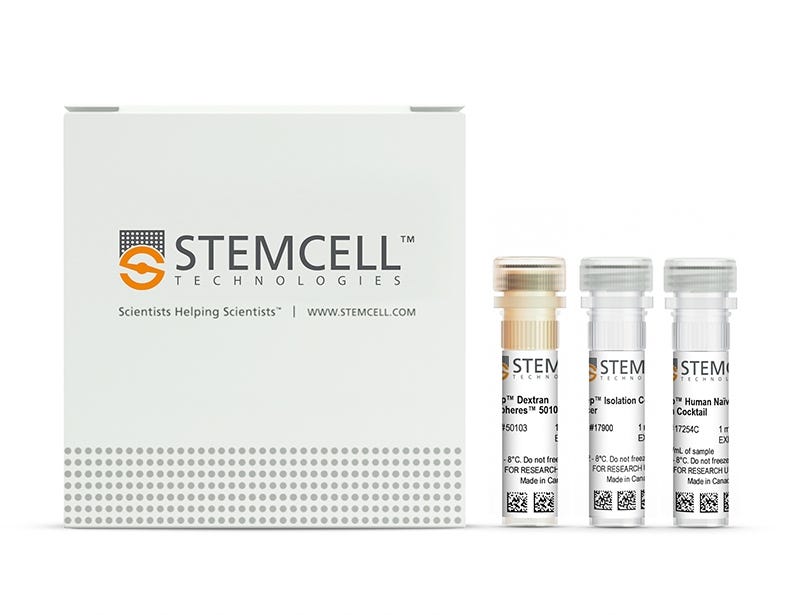
Easily and efficiently isolate highly purified human naïve B cells (CD3-CD19+CD27-) from fresh or previously frozen human peripheral blood mononuclear cells (PBMCs) or washed leukapheresis samples by immunomagnetic negative selection, with the EasySep™ Human Naïve B Cell Isolation Kit. Widely used in published research for more than 20 years, EasySep™ combines the specificity of monoclonal antibodies with the simplicity of a column-free magnetic system.
In this EasySep™ negative selection procedure, unwanted cells are labeled with antibody complexes and magnetic particles. Unwanted cells expressing the following markers are targeted for removal: CD2, CD14, CD16, CD27, CD36, CD43, and glyA. The magnetically labeled cells are then separated from the untouched desired naïve B cells by using an EasySep™ magnet and simply pouring or pipetting the desired cells into a new tube. Following magnetic cell isolation in as little as 9 minutes, the desired naïve B cells are ready for downstream applications such as flow cytometry, culture, or DNA/RNA extraction.
This product can be used in place of the EasySep™ Human Naïve B Cell Enrichment Kit (Catalog #19254) for even faster cell isolations.
Learn more about how immunomagnetic EasySep™ technology works or how to fully automate immunomagnetic cell isolation with RoboSep™. Explore additional products optimized for your workflow, including culture media, supplements, antibodies, and more.
Figure 1. Typical EasySep™ Human Naïve B Cell Isolation Profile
Starting with human PBMCs, the naïve B cell (CD3-CD19+CD27-) content of the isolated fraction is typically 94.9 ± 2.2% (mean ± SD). In the above example, the purities of the start and final isolated fractions are 7.1% and 97.7%, respectively.
This product is designed for use in the following research area(s) as part
of the highlighted workflow stage(s). Explore these workflows to learn more about the other products we
offer to support each research area.
Can EasySep™ be used for either positive or negative selection?
Yes. The EasySep™ kits use either a negative selection approach by targeting and removing unwanted cells or a positive selection approach targeting desired cells. Depletion kits are also available for the removal of cells with a specific undesired marker (e.g. GlyA).
How does the separation work?
Magnetic particles are crosslinked to cells using Tetrameric Antibody Complexes (TAC). When placed in the EasySep™ Magnet, labeled cells migrate to the wall of the tube. The unlabeled cells are then poured off into a separate fraction.
Which columns do I use?
The EasySep™ procedure is column-free. That's right - no columns!
How can I analyze the purity of my enriched sample?
The Product Information Sheet provided with each EasySep™ kit contains detailed staining information.
Can EasySep™ separations be automated?
Yes. RoboSep™, the fully automated cell separator, automates all EasySep™ labeling and cell separation steps.
Can EasySep™ be used to isolate rare cells?
Yes. We recommend a cell concentration of 2x10⁸ cells/mL and a minimum working volume of 100 µL. Samples containing 2x10⁷ cells or fewer should be suspended in 100 µL of buffer.
Are the EasySep™ magnetic particles FACS-compatible?
Yes, the EasySep™ particles are flow cytometry-compatible, as they are very uniform in size and about 5000X smaller than other commercially available magnetic beads used with column-free systems.
Can the EasySep™ magnetic particles be removed after enrichment?
No, but due to the small size of these particles, they will not interfere with downstream applications.
Can I alter the separation time in the magnet?
Yes; however, this may impact the kit's performance. The provided EasySep™ protocols have already been optimized to balance purity, recovery and time spent on the isolation.
For positive selection, can I perform more than 3 separations to increase purity?
Yes, the purity of targeted cells will increase with additional rounds of separations; however, cell recovery will decrease.
How does the binding of the EasySep™ magnetic particle affect the cells? is the function of positively selected cells altered by the bound particles?
Hundreds of publications have used cells selected with EasySep™ positive selection kits for functional studies. Our in-house experiments also confirm that selected cells are not functionally altered by the EasySep™ magnetic particles.
If particle binding is a key concern, we offer two options for negative selection. The EasySep™ negative selection kits can isolate untouched cells with comparable purities, while RosetteSep™ can isolate untouched cells directly from whole blood without using particles or magnets.
In vitro recapitulation of intramuscular mRNA vaccination with naive and recall antigens using a human lymphoid follicle chip platform.
Y. Zhai et al.
iScience 2026 Jul
Abstract
Predicting the efficacy and toxicity of mRNA vaccines remains challenging. We describe an in vitro human model that replicates immune responses to lipid nanoparticle (LNP)-based mRNA vaccines upon intramuscular injection. Vaccines are administered to human skeletal myoblasts and antigen-presenting cells (APCs). Non-amplifying mRNA (NAM) vaccines directly induce antigen expression in APCs, whereas self-amplifying mRNA (SAM) vaccines require muscle cell-APC contact. The transfer of APCs and soluble factors to a microfluidic human lymphoid follicle chip (LF Chip), to mimic lymphatic drainage, induces LF expansion, de novo immunoglobulin G (IgG) production against a naive antigen, and cytokine release, with responses varying by LNP type. Similar vaccination of LF chips with Moderna vaccine against SARS-CoV-2 spike recall antigen generates neutralizing antibodies and induces somatic hypermutation (SHM). These studies offer an all-human alternative for evaluating vaccine-induced immunity, limiting the need for non-human primates and accelerating vaccine development.
ETS-guided iPSC-endothelial models recapitulate malaria pathogenesis.
F. Korbmacher et al.
EMBO molecular medicine 2026 Aug
Abstract
The sequestration of the malaria parasite in the microvasculature is a major driver of severe malaria, but the human specificity of Plasmodium falciparum has challenged our understanding of this key pathogenic process. Advances in induced pluripotent stem cell (iPSC) technologies offer unique opportunities to study parasite-host interactions in a well-defined environment. However, endothelial iPSC differentiation methods often result in cells with mixed epithelial identity. Here, we have generated an iPSC line with inducible and simultaneous expression of ETS transcription factors (ETV2, FLI1, ERG), resulting in cells with improved endothelial identity and strong barrier function (ETS-iBMEC). Parasite-infected red blood cells and neutrophils display high binding to ETS-iBMEC. Exposure to parasite products caused transcriptional changes in metabolic and splicing genes, and key endothelial barrier and angiogenic pathways. Our study confirms the role of the angiopoietin-Tie2 axis in parasite-mediated barrier disruption and highlights the importance of new pathways, including VEGF-Notch signalling. Our novel iPSC-based approach represents a new in vitro platform to study the pathogenesis of human vascular infections.
Replication competent HIV-guided CRISPR screen identifies antiviral factors including targets of the accessory protein Nef
Nature Communications 2024 May
Abstract
Innate antiviral factors are essential for effective defense against viral pathogens. However, the identity of major restriction mechanisms remains elusive. Current approaches to discover antiviral factors usually focus on the initial steps of viral replication and are limited to a single round of infection. Here, we engineered libraries of >1500 replication-competent HIV-1 constructs each expressing a single gRNAs to target >500 cellular genes for virus-driven discovery of antiviral factors. Passaging in CD4+ T cells robustly enriched HIV-1 encoding sgRNAs against GRN, CIITA, EHMT2, CEACAM3, CC2D1B and RHOA by >50-fold. Using an HIV-1 library lacking the accessory nef gene, we identified IFI16 as a Nef target. Functional analyses in cell lines and primary CD4+ T cells support that the HIV-driven CRISPR screen identified restriction factors targeting virus entry, transcription, release and infectivity. Our HIV-guided CRISPR technique enables sensitive discovery of physiologically relevant cellular defense factors throughout the entire viral replication cycle. Innate immune mechanisms are critical for antiviral defense. Here, the authors developed a CRISPR/Cas9-based HIV-driven approach to identify cellular factors compromising viral transcription, assembly, release or infectivity in human T cells. They identify targets of the Nef protein as antiviral factors.
Hamster (Armenian) monoclonal IgG1 antibody against human, mouse, rat CD27
Item added to your cart
EasySep™ Human Naïve B Cell Isolation Kit
Quality Statement:
PRODUCTS ARE FOR RESEARCH USE ONLY AND NOT INTENDED FOR HUMAN OR ANIMAL DIAGNOSTIC OR THERAPEUTIC USES UNLESS OTHERWISE STATED. FOR ADDITIONAL INFORMATION ON QUALITY AT STEMCELL, REFER TO WWW.STEMCELL.COM/COMPLIANCE.