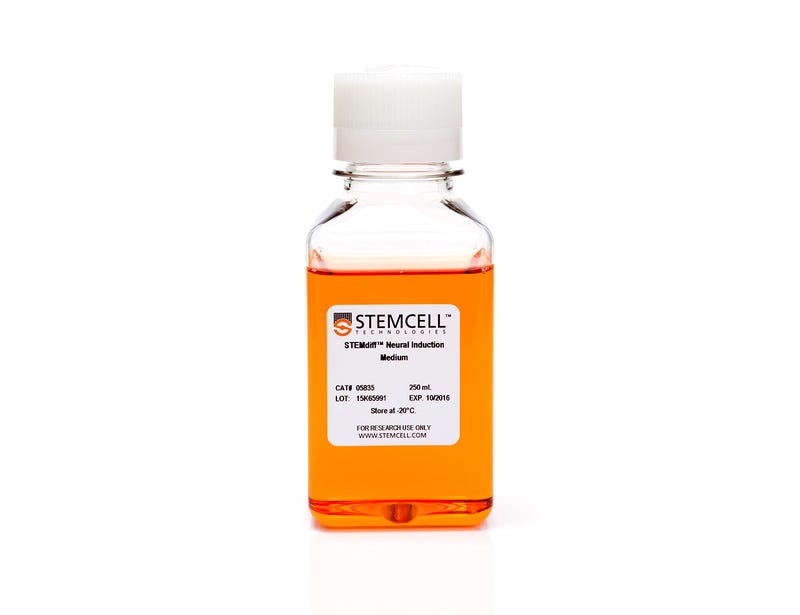
STEMdiff™ Neural Induction Medium

Defined, serum-free medium for neural induction of human ES and iPS cells
Need a high-quality cell source? Choose from our hiPSC healthy control lines, manufactured with mTeSR™ Plus.

STEMdiff™ Neural Induction Medium

Defined, serum-free medium for neural induction of human ES and iPS cells

From: 411 USD
Catalog #
(Select a product)
Defined, serum-free medium for neural induction of human ES and iPS cells
Add to Wish List

Product Advantages


  • Defined and serum-free

  • Rapid and efficient neural induction

  • Compatible with both embryoid body and monolayer culture protocols

  • Reproducible differentiation of multiple ES cell and iPS cell lines maintained in mTeSR™ Plus, mTeSR™ 1, or TeSR™-AOF

  • Convenient, user-friendly format and protocols

What's Included

  • STEMdiff™ Neural Induction Medium, 250 mL (Catalog #05835)
  • STEMdiff™ Neural Induction Medium, 2 x 250 mL (Catalog #05839)

Overview

STEMdiff™ Neural Induction Medium is a defined, serum-free medium for the neural induction of human embryonic stem (ES) cells and induced pluripotent stem (iPS) cells. This medium enables highly efficient generation of neural progenitor cell using either embryoid body- or monolayer culture-based protocols.

Learn how to generate neural progenitor cells from human pluripotent stem cells (hPSCs) in our On-Demand Neural Induction Course, and browse our Tech Tips on the Neural Induction of hPSCs using the Embryoid Body Method or Monolayer Method.
Subtype
Specialized Media
Cell Type
Neural Cells, PSC-Derived, Neural Stem and Progenitor Cells, Pluripotent Stem Cells
Species
Human
Application
Cell Culture, Differentiation
Brand
STEMdiff
Area of Interest
Disease Modeling, Neuroscience, Stem Cell Biology
Formulation Category
Serum-Free

Protocols and Documentation

Find supporting information and directions for use in the Product Information Sheet or explore additional protocols below.

Document Type
Product Name
Catalog #
Lot #
Language
Catalog #
05839, 05835
Lot #
All
Language
English
Document Type
Technical Manual
Catalog #
05835
Lot #
All
Language
English
Document Type
Safety Data Sheet
Catalog #
05839, 05835
Lot #
All
Language
English

Applications

This product is designed for use in the following research area(s) as part of the highlighted workflow stage(s). Explore these workflows to learn more about the other products we offer to support each research area.

Resources and Publications

Educational Materials (20)

On-Demand Training

Publications (61)

AHA1 Regulates Aβ Production via Modulation of APP Abundance and γ-Secretase Assembly. A. Noorani et al. Journal of neurochemistry 2026 Sep

Abstract

Deposition of amyloid β-protein (Aβ) is a hallmark of Alzheimer's disease (AD), produced by γ-secretase-mediated cleavage of amyloid precursor protein (APP). The 90-kDa heat shock protein (Hsp90) co-chaperone, activator of Hsp90 ATPase homolog 1 (AHA1), is known to promote the accumulation of toxic tau species; however, its effects on Aβ production remain unclear. Using cellular models-including human embryonic kidney 293 T (HEK293T) cells, stable HEK-APP cells, presenilin 1/2 double-knockout mouse embryonic fibroblasts (PS-DKO MEFs), and Chinese hamster ovary (CHO) cells-in which AHA1 was experimentally manipulated, together with observational analyses of human iPSC-derived neurons carrying an FAD-linked APP mutation, we demonstrate that AHA1 regulates Aβ generation through two mechanisms: regulation of APP protein abundance through pathways that are at least partially independent of Hsp90 interaction and Hsp90-dependent promotion of γ-secretase assembly. Knockdown of endogenous AHA1 reduces Aβ production and decreases APP and γ-secretase component levels, whereas AHA1 overexpression elevates Aβ generation and increases the expression of these proteins. The AHA1-E67K mutant, which has impaired Hsp90 binding, lowers Aβ production and the levels of APP and γ-secretase components compared with wild-type AHA1. AHA1 associates with APP and APH1, an immature γ-secretase component, indicating its role in APP proteolysis and Aβ production. Disruption of the AHA1/Hsp90 complex-through AHA1 knockdown, the E67K mutant, or a small-molecule inhibitor-reduces γ-secretase assembly. Notably, Familial AD mutations (APP-C99-I45F, PS1-L286V) upregulate AHA1/Hsp90, elevating APP/APH1 and Aβ42 production. AHA1 knockdown rescues FAD-linked Aβ42 overproduction in a mutant cell model, while AHA1 overexpression exacerbates PS1 mutant Aβ production. Collectively, these findings reveal that AHA1 regulates Aβ production by modulating APP abundance and γ-secretase assembly, establishing AHA1 as a potential target for therapeutic intervention in AD.
Consequences of the Novel ALS-Associated KIF5A Variant c.2993-6C > A for Exon 27 Splicing and Axonal Transport of SFPQ G. A. Rouleau et al. Neurology: Genetics 2026 Mar

Abstract

Background and Objectives: Recent studies have identified variants in the kinesin family member 5A (KIF5A) gene that predispose to amyotrophic lateral sclerosis (ALS). These ALS-linked KIF5A variants lead to the exclusion of exon 27, resulting in the production of a mutated protein with an altered C-terminal region (KIF5A ΔExon27). Through whole genome sequencing, we identified a novel KIF5A intronic variant, rs1057522322 (c.2993-6C > A; chr12:57582596C > A, GRCh38.p14), in a family segregating ALS. Our goal is to investigate the effect of this variant on exon 27 splicing and to assess its functional consequences on KIF5A-mediated cargo transport. Methods: Induced pluripotent stem cells (iPSCs) were generated from siblings with and without the c.2993-6C > A variant. RT-PCR was performed on RNA extracted from iPSC-derived neurons to assess exon 27 splicing. Functional studies were conducted on iPSC-derived motor neurons (MNs). Results: RT-PCR confirmed that the c.2993-6C > A variant induced exon 27 skipping in KIF5A. Immunofluorescent staining showed that KIF5A ΔExon27 abolished the axonal interaction with splicing factor proline- and glutamine-rich, a cargo specifically transported by KIF5A. Under stress conditions, MNs carrying the c.2993-6C > A variant exhibited TDP-43 proteinopathy. Discussion: KIF5A intronic variant c.2993-6C > A could be a risk factor for ALS. KIF5A ΔExon27 impairs KIF5A-mediated cargo transport and contributes to ALS pathogenesis in a TDP-43–dependent manner.
Kat5 cKO mouse replicates biological domain signatures associated with Alzheimer's disease. G. Cary et al. Alzheimer's & dementia : the journal of the Alzheimer's Association 2026 Jul

Abstract

INTRODUCTION: Alzheimer's disease (AD) can be caused by autosomal-dominant familial Alzheimer's disease (FAD) mutations in amyloid precursor protein (APP) or presenilin-1 and 2, which form an enzyme substrate complex. KAT5 binds to the APP intracellular domain. Recent reports of decreased γ-secretase activity in FAD mutants support KAT5 membrane sequestration. METHODS: We compare the hippocampal transcriptome profiles of the Kat5 brain-specific knockout (KO) mouse to multiple AD datasets through alignment with the TREAT-AD AD biological domains. We examine KAT5 subcellular localization in human wild-type and AD neurons. RESULTS: The Kat5 KO mouse demonstrates downregulation of synaptic genes, metabolic pathways, and upregulation of DNA replication and repair, cell cycle, and immune response genes. We see similar profiles in Kat5 and comparative AD datasets. KAT5 is restricted to the cytosol in human AD neurons. DISCUSSION: This analysis supports the hypothesis that KAT5 nuclear signaling downstream of APP cleavage plays a pivotal role in neuronal homeostasis.
Need a high-quality cell source? Choose from our hiPSC healthy control lines, manufactured with mTeSR™ Plus.