Thank you for your interest in this product.
Please provide us with your contact information and your local representative
will contact you with a customized quote. Where appropriate, they can also assist you with a(n):
Estimated delivery time for your area
Product sample or exclusive offer
In-lab demonstration
By submitting this form, you are providing your consent to STEMCELL Technologies Canada Inc. and its subsidiaries and affiliates (“STEMCELL”) to collect and use your information, and send you newsletters and emails in accordance with our privacy policy. Please contact us with any questions that you may have. You can unsubscribe or change your email preferences at any time.
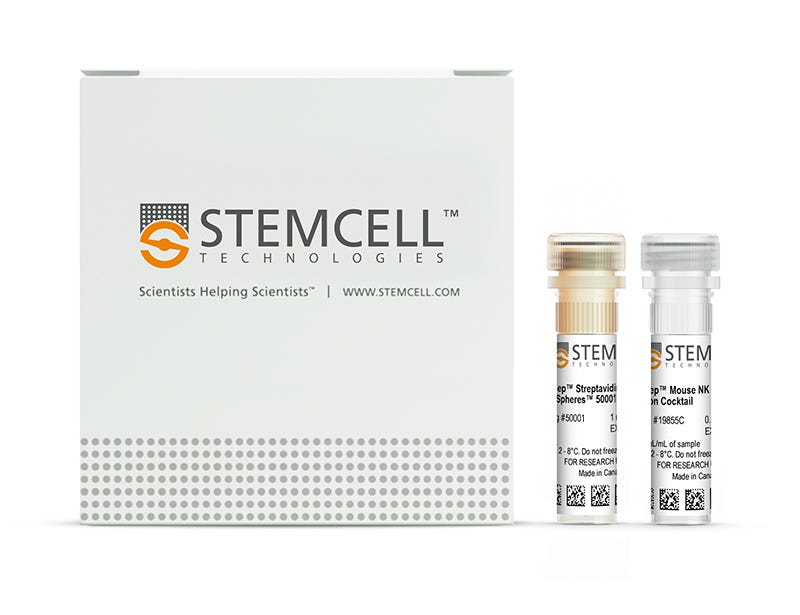
Easily and efficiently isolate highly purified mouse natural killer (NK) cells (CD3-CD49b+) from single-cell suspensions of mouse splenocytes and other tissue samples by immunomagnetic negative selection, with the EasySep™ Mouse NK Cell Isolation Kit. Widely used in published research for more than 20 years, EasySep™ combines the specificity of monoclonal antibodies with the simplicity of a column-free magnetic system.
In this EasySep™ negative selection procedure, unwanted cells are labeled with antibody complexes and magnetic particles. Unwanted cells expressing the following markers are targeted for removal: CD4, CD5, Ly6G, CD8a, F4/80, CD3e, CD19, CD24, TCRgd, and 7-4. The magnetically labeled cells are then separated from the untouched desired NK cells by using an EasySep™ magnet and simply pouring or pipetting the desired cells into a new tube. Following magnetic cell isolation in as little as 25 minutes, the desired NK cells are ready for downstream applications such as flow cytometry, culture, or cell-based assays.
Learn more about how immunomagnetic EasySep™ technology works or how to fully automate immunomagnetic cell isolation with RoboSep™. Explore additional products optimized for your workflow, including culture media, supplements, antibodies, and more.
This product is designed for use in the following research area(s) as part
of the highlighted workflow stage(s). Explore these workflows to learn more about the other products we
offer to support each research area.
Can EasySep™ be used for either positive or negative selection?
Yes. The EasySep™ kits use either a negative selection approach by targeting and removing unwanted cells or a positive selection approach targeting desired cells. Depletion kits are also available for the removal of cells with a specific undesired marker (e.g. GlyA).
How does the separation work?
Magnetic particles are crosslinked to cells using Tetrameric Antibody Complexes (TAC). When placed in the EasySep™ Magnet, labeled cells migrate to the wall of the tube. The unlabeled cells are then poured off into a separate fraction.
Which columns do I use?
The EasySep™ procedure is column-free. That's right - no columns!
How can I analyze the purity of my enriched sample?
The Product Information Sheet provided with each EasySep™ kit contains detailed staining information.
Can EasySep™ separations be automated?
Yes. RoboSep™, the fully automated cell separator, automates all EasySep™ labeling and cell separation steps.
Can EasySep™ be used to isolate rare cells?
Yes. We recommend a cell concentration of 2x10⁸ cells/mL and a minimum working volume of 100 µL. Samples containing 2x10⁷ cells or fewer should be suspended in 100 µL of buffer.
Are the EasySep™ magnetic particles FACS-compatible?
Yes, the EasySep™ particles are flow cytometry-compatible, as they are very uniform in size and about 5000X smaller than other commercially available magnetic beads used with column-free systems.
Can the EasySep™ magnetic particles be removed after enrichment?
No, but due to the small size of these particles, they will not interfere with downstream applications.
Can I alter the separation time in the magnet?
Yes; however, this may impact the kit's performance. The provided EasySep™ protocols have already been optimized to balance purity, recovery and time spent on the isolation.
For positive selection, can I perform more than 3 separations to increase purity?
Yes, the purity of targeted cells will increase with additional rounds of separations; however, cell recovery will decrease.
How does the binding of the EasySep™ magnetic particle affect the cells? is the function of positively selected cells altered by the bound particles?
Hundreds of publications have used cells selected with EasySep™ positive selection kits for functional studies. Our in-house experiments also confirm that selected cells are not functionally altered by the EasySep™ magnetic particles.
If particle binding is a key concern, we offer two options for negative selection. The EasySep™ negative selection kits can isolate untouched cells with comparable purities, while RosetteSep™ can isolate untouched cells directly from whole blood without using particles or magnets.
Protocol for immunomagnetic enrichment of T cells from complex murine tissues
E. Trolio et al.
STAR Protocols 2026 Mar
Abstract
SummaryT cells are the central effectors and regulators of the adaptive immune response. This protocol provides a step-by-step approach for isolating and enriching total T cells by negative selection from complex murine tissues, including bone marrow (BM), liver, heart, and kidneys. We describe steps for tissue harvesting, preparation of single-cell suspensions, and immunomagnetic enrichment. We then outline procedures for flow cytometric assessment of cell purity and viability. This protocol enables efficient recovery of high-quality T cells for reliable downstream analyses. Graphical abstract Highlights•Isolation of leukocytes from murine BM, liver, heart and kidneys•Non-enzymatic dissociation of kidney and heart tissue•Protocol for immunomagnetic enrichment of T cells•Flow cytometry analysis of T cell purity and viability Publisher’s note: Undertaking any experimental protocol requires adherence to local institutional guidelines for laboratory safety and ethics. T cells are the central effectors and regulators of the adaptive immune response. This protocol provides a step-by-step approach for isolating and enriching total T cells by negative selection from complex murine tissues, including bone marrow (BM), liver, heart, and kidneys. We describe steps for tissue harvesting, preparation of single-cell suspensions, and immunomagnetic enrichment. We then outline procedures for flow cytometric assessment of cell purity and viability. This protocol enables efficient recovery of high-quality T cells for reliable downstream analyses.
Non-canonical NF-κB drives a fate switch from germinal center to early effector B cells.
W. Nawaz et al.
iScience 2026 Aug
Abstract
The non-canonical (NC) NF-κB pathway controls peripheral B-cell survival and follicular organization, pointing to a regulatory role during active adaptive immune responses. Here, we show that NC NF-κB activity is selectively attenuated in human germinal center B cells (GCBs), the population required to generate high-affinity antibodies, while remaining elevated in effector B cells. Accordingly, enforced NC NF-κB activation in murine B cells resulted in near-complete loss of GCB and high-affinity antibody production following immunization. These effects were primarily driven by NC NF-κB-induced reshaping of the immune microenvironment: activated B cells secreted IL-10, triggering premature expansion of regulatory T cells, limiting T cell help, and suppressing germinal center responses. Blocking IL-10 signaling was sufficient to normalize the niche and restore GCB. Concurrently, NC NF-κB activation promoted rapid B-cell differentiation into low-affinity antibody-secreting cells. Together, these findings identify NC NF-κB as a tunable rheostat linking B-cell signaling, immune-niche control, and humoral immunity.
Polatuzumab Vedotin Enhances Intratumoral T-Cell Infiltration and Demonstrates Combinatorial Efficacy With Anti-CD20/CD3 Bispecific Antibody in a Syngeneic B-Cell Malignancy Mouse Model.
M. Tomita et al.
EJHaem 2026 Aug
Abstract
INTRODUCTION: Polatuzumab vedotin (Pola) is an anti-CD79b antibody-drug conjugate. Clinical evidence supports the combination efficacy of Pola with mosunetuzumab or glofitamab, both anti-CD20/CD3 bispecific antibodies (anti-CD20/CD3 BsAbs). However, the influence of Pola on the tumor microenvironment and its impact on the efficacy of anti-CD20/CD3 BsAb remains unclear. RESULTS: In a syngeneic mouse model, Pola significantly increased tumor-infiltrating T cells and innate immune cells. Moreover, Pola also upregulated the levels of cytokine and chemokine involved in T-cell infiltration. The Pola + anti-CD20/CD3 BsAb combination showed superior anti-tumor efficacy versus each monotherapy. CONCLUSION: These findings suggest Pola enhances immune cell infiltration into tumors and could enhance the efficacy of anti-CD20/CD3 BsAb. TRIAL REGISTRATION: The authors have confirmed clinical trial registration is not needed for this submission.
(C3H x BALB/c) F1 hybrid monoclonal IgG2a antibody against mouse NK1.1 (CD161)
Item added to your cart
EasySep™ Mouse NK Cell Isolation Kit
Quality Statement:
PRODUCTS ARE FOR RESEARCH USE ONLY AND NOT INTENDED FOR HUMAN OR ANIMAL DIAGNOSTIC OR THERAPEUTIC USES UNLESS OTHERWISE STATED. FOR ADDITIONAL INFORMATION ON QUALITY AT STEMCELL, REFER TO WWW.STEMCELL.COM/COMPLIANCE.