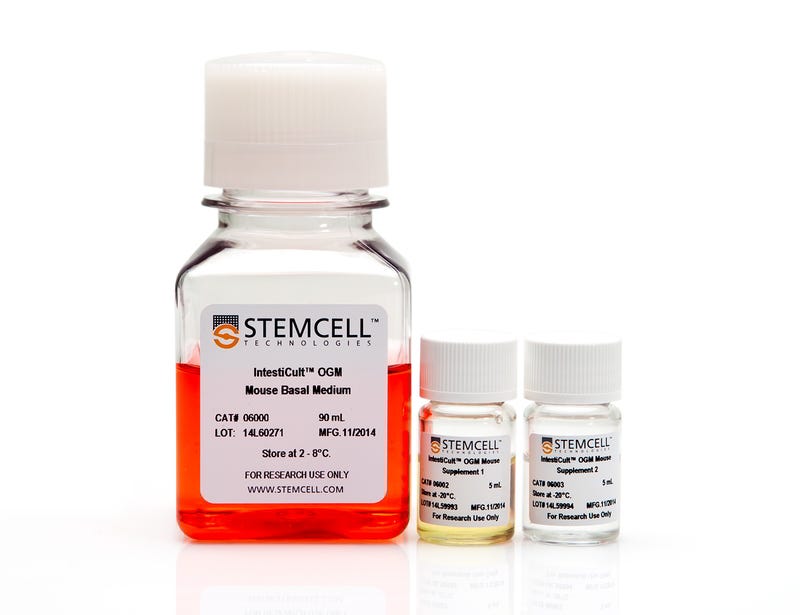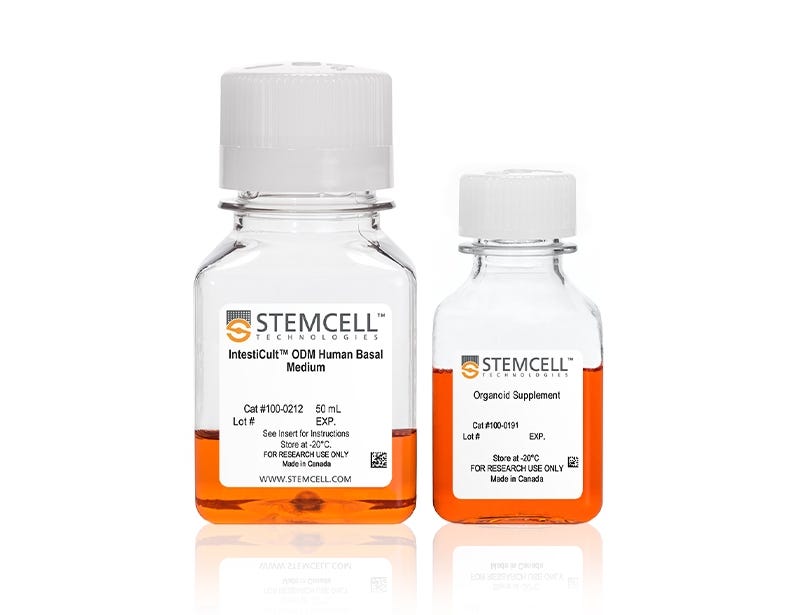
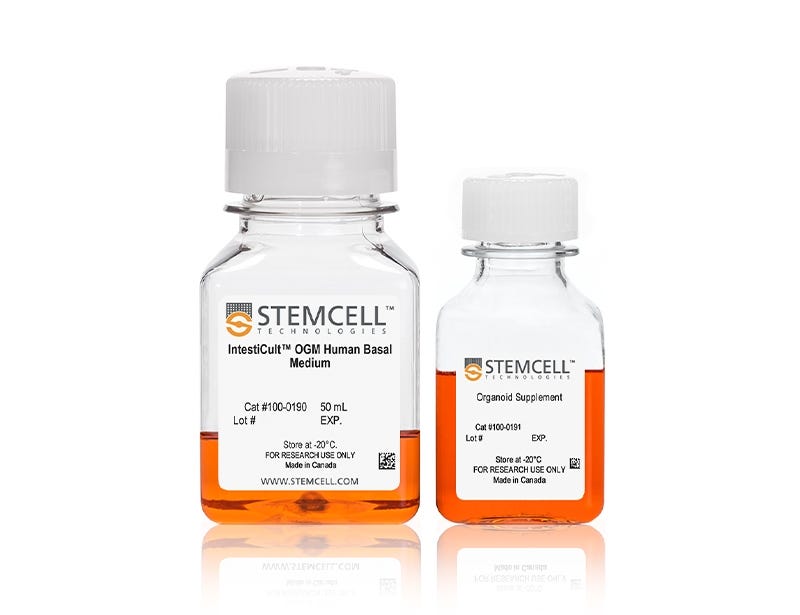
IntestiCult™ Intestinal Organoid Culture Media
IntestiCult™ organoid culture media are complete growth media that support establishment, expansion, long-term maintenance, and further differentiation of intestinal organoid cultures from human, rat, or mouse intestinal crypts. Based on formulations by Dr. Hans Clevers and HUB Organoids, these complete and defined media generate organoids from intestinal crypts in less than one week. These “mini-guts” retain the crypt- and villus-like domains, a central lumen, and all major cell types found in the adult intestinal epithelium. The organoids are functional and ready for use in a number of research applications, including disease modeling, drug screening, and tissue regeneration.
Addressing the Challenges in Intestinal Research
Studying the intestinal epithelium can pose multiple challenges. Traditional in vitro monolayer cultures are convenient but lack key structural features and the cellular diversity of an adult intestine. In vivo animal models allow experimentation on an intact intestine but are often more difficult and expensive to run, and provide limited relevance to human physiology. Intestinal organoids address many of these issues by providing a convenient in vitro system that has high physiological relevance.
What are Intestinal Organoids?
Intestinal organoids are three-dimensional multicellular structures that retain key features of the adult intestinal epithelium, such as the crypt- and villus-like domains, a central lumen, and the major cell types: intestinal stem cells, paneth cells, goblet cells, enteroendocrine cells, and enterocytes. Organoid culture is a convenient and physiologically relevant tool that can be used in a variety of research applications.
Why Use IntestiCult™?
- Use complete media that does not require additional growth factors
- Generate organoids that retain key features and all major cell types found in the adult intestinal epithelium
- Achieve efficient and reproducible intestinal organoids in under one week
- Follow a simple format and easy-to-use, optimized protocols
Find the Right Media for Your Intestinal Research
Use the Interactive Product Finder to determine which IntestiCult™ media is best suited for your intestinal epithelial cell research.
Brand History
Dr. Hans Clevers and his research team have made significant contributions to the field of stem cells and organoid culture. In 2007, Dr. Nick Barker et al. identified the presence of LGR5+ stem cells in the intestinal crypt. In 2009, Dr. Toshiro Sato et al. published a protocol for establishing organoid structures from intestinal crypts or single intestinal stem cells. The protocol described the culture conditions that would support long-term expansion of these organoids without requiring a mesenchymal niche. In 2014, Dr. Clevers and The HUB foundation for Organoid Technology signed an agreement with STEMCELL Technologies to manufacture and distribute cell culture media for organoids. Since then, the release of IntestiCult™ Organoid Growth Medium (Mouse) in 2015, and IntestiCult™ Organoid Growth Medium (Human) in 2017 has provided researchers with a convenient, complete and affordable medium for establishing organoid cultures.
Watch a webinar on organoids as a model for human disease by Dr. Clevers >
In 2025, STEMCELL Technologies introduced IntestiCult™ Plus, a next-generation intestinal organoid culture medium. Building on nearly a decade of innovation, IntestiCult™ Plus was developed to support simultaneous expansion and differentiation of intestinal organoids, eliminating the tradeoff between growth and cellular complexity. This serum- and conditioned medium-free formulation improves physiological relevance by promoting the development of diverse intestinal cell types, including tuft cells and mature enterocytes, in a single culture system. IntestiCult™ Plus continues the brand’s legacy of delivering consistent, scalable, and high-performance solutions to advance intestinal organoid research.
Watch a webinar on IntestiCult™ Plus with Dr. Martin Stahl >
We are pleased that STEMCELL will be our partner in making specialty media for growth of organoids available to the scientific community. The broad availability of off-the-shelf cell culture media from a world leader in the development of specialized cell culture media and cell separation products represents an essential step in the further implementation of this exciting technology.
Dr. Hans Clevers, Founding Director of The HUB
Scientific Resources
Explore our resources to learn more about organoids, and learn how to generate, culture, and differentiate intestinal organoids.
- Protocols and Technical Tips
- Webinars and Videos
- Organoid Research Techniques E-book
- Online Learning Classroom
Key Applications of Intestinal Organoids
Epithelial Cell Biology
Intestinal Stem Cell Niche
Gene Expression and Function
Transplantation and Engraftment
Cystic Fibrosis
Schwank G et al. (2013) Functional repair of CFTR by CRISPR/Cas9 in intestinal stem cell organoids of cystic fibrosis patients. Cell Stem Cell 13(6): 653-8.
Cancer
Ye Q et al (2024) Orchestrating NK and T cells via tri-specific nano-antibodies for synergistic antitumor immunity. Nat Commun 15, 6211.
Kim S et al. (2023) YWHAZ and TBP are potential reference gene candidates for qPCR analysis of response to radiation therapy in colorectal cancer. Sci Rep 13, 12902.
Lee SH et al. (2023) Apposition of Fibroblasts with Metaplastic Gastric Cells Promotes Dysplastic Transition. Gastroenterology. 165(2): 374–90.
Yao L et al. (2022) Application of tumoroids derived from advanced colorectal cancer patients to predict individual response to chemotherapy. J Chemother 35(2): 104–16.
Sui Q et al. (2021) Dickkopf 1 impairs the tumor response to PD-1 blockade by inactivating CD8+ T cells in deficient mismatch repair colorectal cancer. J Immunother Cancer 9(3): e001498.
Li Y et al. (2020) Butyrate enhances the efficacy of radiotherapy via FOXO3A in colorectal cancer. Int J Oncol 57(6): 1307–18.
Nag D et al. (2019) Auranofin protects intestine against radiation injury by modulating p53/p21 pathway and radiosensitizes human colon tumor. Clin Cancer Res 25(15): 4791–807.
Tsai S et al. (2018) Development of primary human pancreatic cancer organoids, matched stromal and immune cells and 3D tumor microenvironment models. BMC Cancer 18(1): 335.
Banerjee A et al. (2016) Endoplasmic reticulum stress and IRE-1 signaling cause apoptosis in colon cancer cells in response to andrographolide treatment. Oncotarget 7(27): 41432–44.
Matano M et al. (2015) Modeling colorectal cancer using CRISPR-Cas9-mediated engineering of human intestinal organoids. Nat Med 21(3):256-62.
Drug-Screening
Viral Infection
Li NF et al. (2025) Macrophage phagocytosis of human norovirus-infected cells in an ex vivo human enteroid-macrophage coculture model. mBio 16:301180-25.
Rader A et al. (2025) Autophagy-enhancing strategies to promote intestinal viral resistance and mucosal barrier function in SARS-CoV-2 infection. Autophagy Reports, 4(1).
Hayashi T et al. (2025) Identification of FDA-Approved Drugs That Inhibit SARS-CoV-2 and Human Norovirus Replication. Biological and Pharmaceutical Bulletin 48(7):994-1000.
Ianevski A et al. (2024) The combination of pleconaril, rupintrivir, and remdesivir efficiently inhibits enterovirus infections in vitro, delaying the development of drug-resistant virus variants. Antiviral Res 224: 105842.
Santos-Ferreira A et al. (2024) Molnupiravir inhibits human norovirus and rotavirus replication in 3D human intestinal enteroids. Antiviral Res 223: 105839.
Euller-Nicolas G et al. (2023) Human Sapovirus replication in human intestinal enteroids. J Virol 97: e00383-23.
Guo Y et al. (2021) Infection of porcine small intestinal enteroids with human and pig rotavirus A strains reveals contrasting roles for histo-blood group antigens and terminal sialic acids. PLoS Pathog 17(1): e1009237.
Overbey KN et al. (2021) Optimizing human intestinal enteroids for environmental monitoring of human norovirus. Food Environ Virol 13(4): 470–84.
Lindesmith LC et al. (2019) Sera antibody repertoire analyses reveal mechanisms of broad and pandemic strain neutralizing responses after human norovirus vaccination. Immunity 50(6): 1530–41.e8
Zhu S et al. (2017) Nlrp9b inflammasome restricts rotavirus infection in intestinal epithelial cells. Nature 546: 667–70.
Bacterial Infection
Roodsant TJ et al. (2024) Translocation across a human enteroid monolayer by zoonotic Streptococcus suis correlates with the presence of Gb3-positiv cells. iScience, 27(3):109178.
Baryalai P et al. (2025) Hemagglutinin Protease HapA Associated with Vibrio cholerae Outer Memberane Vesicles (OMVs) Disrupts Tight and Adherens Junctions. J Extracell Vesicles. 14: e70092.
Grüttner J et al. (2023) Trophozoite fitness dictates the intestinal epithelial cell response to Giardia intestinalis infection. PLOS Pathog 19(5): e1011372.
Horvath TD et al. (2023) Interrogation of the mammalian gut–brain axis using LC–MS/MS-based targeted metabolomics with in vitro bacterial and organoid cultures and in vivo gnotobiotic mouse models. Nat Protoc 18: 490–529.
Xiong Z et al. (2022) Intestinal Tuft-2 cells exert antimicrobial immunity via sensing bacterial metabolite N-undecanoylglycine. Immunity 55(4): 686–700.e7
Yue R et al. (2020) Essential role of IFN-γ in regulating gut antimicrobial peptides and microbiota to protect against alcohol-induced bacterial translocation and hepatic inflammation in mice. Front Physiol 11: 629141.
Sittipo P et al. (2020) Irradiation-induced intestinal damage is recovered by the indigenous gut bacteria Lactobacillus acidophilus. Front Cell Infect Microbiol 10: 415.
Ishii Y et al. (2018) Activation of signal transduction and activator of transcription 3 signaling contributes to Helicobacter-associated gastric epithelial proliferation and inflammation. Gastroenterol Res Pract 2018: 9050715.
Farin HF et al (2014) Paneth cell extrusion and release of antimicrobial products is directly controlled by immune cell-derived IFN-γ. J Exp Med 211(7): 1393–405.
Wilson SS et al. (2014) A small intestinal organoid model of non-invasive enteric pathogen-epithelial cell interactions. Mucosal Immunol 8(2): 352–61.
Zhang YG et al. (2014) Salmonella-infected crypt-derived intestinal organoid culture system for host-bacterial interactions. Physiol Rep 2(9): e12147.
Inflammation
Bao LL et al. (2025) Epithelial OPA1 links mitochondrial fusion to inflammatory bowel disease. Sci Transl Med. 17(781):eadn8699.
Pei Y et al. (2025) Mitsugumin 53 drives stem cell differentiation easing intestinal injury and inflammation. Signal Transduct Target Ther. 10(1):183.
Kaya GG et al. (2025) Unfolded protein response transcription factor XBP1 suppresses necroptosis-induced colitis by reinforcing the mucus barrier. Immunity. 58(9):2208–25.
Yang X et al. (2024) Btbd8 deficiency reduces susceptibility to colitis by enhancing intestinal barrier function and suppressing inflammation. Front Immunol 15: 1382661.
Mishra SP et al. (2023) A mechanism by which gut microbiota elevates permeability and inflammation in obese/diabetic mice and human gut. Gut 72(10): 1848–65.
Wahida A et al. (2021) XIAP restrains TNF-driven intestinal inflammation and dysbiosis by promoting innate immune responses of Paneth and dendritic cells. Sci Immunol 6: eabf7235.
Burgueño JF et al. (2019) Intestinal epithelial cells respond to chronic inflammation and dysbiosis by synthesizing H₂O₂. Front Physiol 10: 1484.
Huang K et al. (2018) Targeting the PXR–TLR4 signaling pathway to reduce intestinal inflammation in an experimental model of necrotizing enterocolitis. Pediatr Res 83(5): 1031–40.
Yassin M et al. (2018) Rectal insulin instillation inhibits inflammation and tumor development in chemically induced colitis. J Crohns Colitis 12(12): 1459–74.
Toxicity
Galli G et al. (2025) Development of Sheep Duodenum Intestinal Organoids and Implementation of High-Throughput Screening Platform for Veterinary Applications. Int. J. Mol. Sci 26(7): 3452.
Akama Y et al. (2024) Extracellular CIRP induces CD4 CD8αα intraepithelial lymphocyte cytotoxicity in sepsis. Mol Med 30: 17.
Rodrigues D et al. (2022) A transcriptomic approach to elucidate the mechanisms of gefitinib‑induced toxicity in healthy human intestinal organoids. Int J Mol Sci 23: 2213.
Rodrigues D et al. (2022) Unravelling mechanisms of doxorubicin‑induced toxicity in 3D human intestinal organoids. Int J Mol Sci 23: 1286.
Tirado FR et al. (2021) Radiation‑induced toxicity in rectal epithelial stem cell contributes to acute radiation injury in rectum. Stem Cell Res Ther 12: 63.
Rodrigues D et al. (2021) New insights into the mechanisms underlying 5‑fluorouracil‑induced intestinal toxicity based on transcriptomic and metabolomic responses in human intestinal organoids. Arch Toxicol 95: 2691–718.
Hale AT et al. (2020) Modulation of sulfur assimilation metabolic toxicity overcomes anemia and hemochromatosis in mice. Adv Biol Regul 76: 100694.