Lymphoprep™

Density gradient medium for the isolation of mononuclear cells

Lymphoprep™

Density gradient medium for the isolation of mononuclear cells
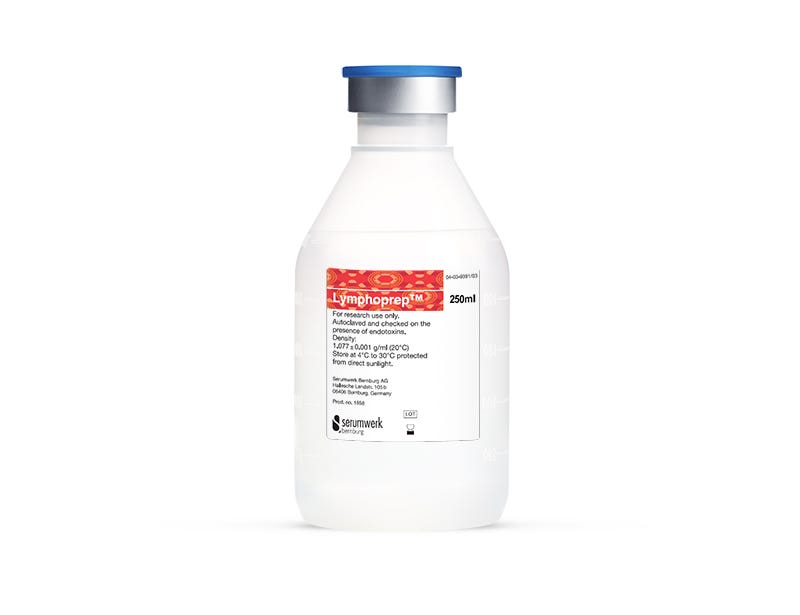
From: 115 USD
Catalog #
(Select a product)
Density gradient medium for the isolation of mononuclear cells
Add to Wish List

Overview

Reliably isolate mononuclear cells from peripheral blood, cord blood, or bone marrow with Lymphoprep™—a cost-effective alternative to Ficoll-Paque™. Use this density gradient medium for rapid, simple, and reliable cell isolation from most blood samples obtained from normal individuals and patients. You can substitute Lymphoprep™ for Ficoll-Paque™ without changing your existing protocols and achieve similar cell purity and recovery rates. This medium is fully compatible with both SepMate™ and RosetteSep™. Formulated with Diatrizoic acid dihydate (9.1% w/v) and polysaccharide (5.7% w/v), Lymphoprep™ has a density of 1.077 g/ml.
Contains

• Diatrizoic acid dihydrate (9.1% w/v)

• Polysaccharide (5.7% w/v)

• Other ingredients

Subtype
Density Gradient Media
Cell Type
Mononuclear Cells
Species
Human
Sample Source
Bone Marrow, Cord Blood, Whole Blood
Selection Method
Negative
Application
Cell Isolation
Brand
Lymphoprep
Area of Interest
Immunology

Data Figures

Figure 1. Purity and Recovery of Cells from Whole Blood When Using Cost-Effective Lymphoprep™ is Comparable to Using Ficoll-Paque™ PLUS

(A) Density gradient centrifugation of peripheral whole blood using Lymphoprep™ results in similar cell purity of mononuclear cells including T cells, B cells, NK cells and monocytes compared to Ficoll-Paque™ PLUS. (B) The recovery of total mononuclear cells and CD45+ cells is also similar. (n = 5, Mean ± SD).

Figure 2. Purity and Recovery of Cells from Cord Blood When Using Cost-Effective Lymphoprep™ is Comparable to Using Ficoll-Paque™ PLUS

(A) Density Gradient centrifugation of cord blood using Lymphoprep™ results in similar cell purity of mononuclear cells including T cells, B cells, NK cells and monocytes compared to Ficoll-Paque™ PLUS. (B) The recovery of total mononuclear cells and CD45+ cells is also similar. (n = 4, Mean ± SD).

Protocols and Documentation

Find supporting information and directions for use in the Product Information Sheet or explore additional protocols below.

Document Type
Product Name
Catalog #
Lot #
Language
Product Name
Lymphoprep™
Catalog #
07861, 18061, 18060, 07811
Lot #
All
Language
Multi
Product Name
Lymphoprep™
Catalog #
07861, 18061, 18060, 07811
Lot #
All
Language
English
Document Type
Safety Data Sheet
Product Name
Lymphoprep™
Catalog #
07861, 07811
Lot #
All
Language
English
Document Type
Safety Data Sheet
Product Name
Lymphoprep™
Catalog #
18061, 18060
Lot #
All
Language
English

Applications

This product is designed for use in the following research area(s) as part of the highlighted workflow stage(s). Explore these workflows to learn more about the other products we offer to support each research area.

Research Area
Workflow Stages

Resources and Publications

Publications (398)

Cigarette smoke and e-cigarette aerosol extracts induce myelopoiesis and suppress inflammatory cytokine production. J. Sullivan et al. Toxicological sciences : an official journal of the Society of Toxicology 2026 Sep

Abstract

Tobacco and nicotine use remain leading preventable drivers of cancer risk, and both combustible cigarettes and electronic nicotine devices perturb immune function and hematopoiesis. However, side-by-side comparisons of their effects across the hematopoietic hierarchy remain limited. Here, we evaluate the impact of cigarette smoke extract (CSE) and e-cigarette vapor extract (EVE) on inflammatory responses in mature myeloid cells and on hematopoietic stem and progenitor cell function using complementary in vitro and in vivo approaches. Using a standardized protocol applied across multiple macrophage models, including RAW264.7 cells, THP-1 macrophages, primary mouse bone marrow-derived macrophages, and human peripheral blood mononuclear cells, we found that CSE consistently suppressed LPS-induced TNF-α secretion in a dose-dependent manner, whereas EVE alone had minimal effect. CSE also induced foam cell formation in macrophages through a reactive oxygen species-dependent mechanism. Additionally, both CSE and EVE suppressed hematopoietic progenitor colony formation. To model real-world exposure patterns, we used a nose-only inhalation system to deliver combustible cigarette smoke followed by e-cigarette aerosol to mice. Sequential smoke and e-cigarette exposure increased platelet counts and myeloid cell frequency, effects not observed with smoking cessation alone. Myeloid skewing persisted through secondary transplantation, indicating durable, cell-intrinsic changes to the hematopoietic stem cell compartment. Together, these findings demonstrate that tobacco and e-cigarette exposures blunt innate immune responsiveness while driving lasting myeloid-biased hematopoiesis, with implications for infection susceptibility, cardiovascular disease, and hematologic malignancy risk.
Identification of a Novel Small Molecule Facilitating HIV Elimination by the "Shock-And-Kill" Approach. Y. Hara et al. Journal of medical virology 2026 Sep

Abstract

Antiretroviral therapy (ART) has markedly improved the prognosis of people living with HIV (PLWH); however, latent viral reservoirs remain a major barrier to a cure. The "Shock and Kill" strategy aims to reactivate latent provirus with latency-reversing agents (LRAs) and subsequently eliminate the infected cells, yet most LRAs characterized to date provide only the "shock" component. Through screening a small-molecule library, we identified 2-hydrido-2,2'-spirobi(1,3,2-benzodioxaphosphole) (2-HSB) as a novel candidate that both reactivates latent HIV provirus and selectively induces cytopathic effects in latently infected reservoir cell lines, thereby exhibiting a dual "Shock and Kill" activity within a single compound. Mechanistically, the HIV-1 tat protein appears to contribute to this selectivity. At the single-cell level, the two effects appeared largely independent, indicating that, under the conditions tested, reactivation was not a consequence of cell death and vice versa. Importantly, 2-HSB induced viral transcription in ex vivo CD4+ T cells from ART-suppressed PLWH. Together, these findings identify 2-HSB as a dual-action candidate that reactivates latent HIV-1 and preferentially induces cytopathic effects in reservoir cell-line models, while supporting further mechanistic and ex vivo validation in primary reservoir-bearing cells.
Cancer cell-selective ectopic expression of CD20 as an antigen enables rituximab repurposing for solid tumour immunotherapy. Z. Kong et al. Clinical and translational medicine 2026 Sep

Abstract

BACKGROUND: Despite the clinical success of cancer immunotherapies, their efficacy is often compromised by antigen-related problems, including downregulation, loss, and off-tumour toxicity. METHODS: To overcome these limitations that challenge the current immunotherapies dependent on native antigens, we here describe a new cancer immunotherapy strategy that artificially and specifically expresses a clinically validated antigen on variant tumours and thus repurposes clinical antibody drugs to treat cancers not belonging to their indications. To authenticate the strategy, we delivered a CD20 gene under the control of an NF-κB-specific promoter to tumours by adeno-associated virus and then treated them with a CD20 antibody, rituximab. RESULTS: We found that CD20 was selectively expressed in tumours, and subsequent rituximab treatment engaged multiple antibody-dependent effector mechanisms, including NK-cell-mediated ADCC and macrophage-mediated ADCP. We demonstrated that this strategy is effective not only in variant-cultivated cancer cells, HCT116 spheroids, and patient-derived organoids of human colorectal cancer, but also in a humanized mouse with an HCT116 xenograft and immunocompetent mouse with an MC38 transplant. The strategy showed high cancer cell specificity in both in vitro and in vivo models, resulting in high therapeutic efficacy. CONCLUSION: This strategy thus creates a new modality of cancer immune-redirection therapy by repurposing both the clinically validated antigen and antibody. KEY POINTS: TRAP enables tumour-selective ectopic expression of the clinically validated antigen CD20, overcoming antigen limitations in solid tumour immunotherapy. TRAP repurposes anti-CD20 antibodies to engage diverse immune effector mechanisms, including ADCC, ADCP, and CDC. TRAP demonstrates antitumour efficacy across cellular, 3D tumour spheroid, patient-derived organoid, and in vivo solid tumour models.