
Immuno-Oncology Research & Immunotherapies for Cancer Treatment
Immuno-oncology is a rapidly advancing field of cancer research that harnesses the body's immune system to recognize, target, and eliminate cancer cells. Researchers develop personalized cancer immunotherapies, including CAR T cell therapies and other engineered immune cell therapies, to overcome immune evasion and improve patient outcomes. STEMCELL Technologies supports discovery and therapeutic development with innovative research tools, high-quality primary cells, scientific resources, and technical expertise.
Explore educational resources, protocols, and research products across key areas of immuno-oncology, including engineered immune cell therapies, cancer biomarkers, preclinical cancer models, and more.
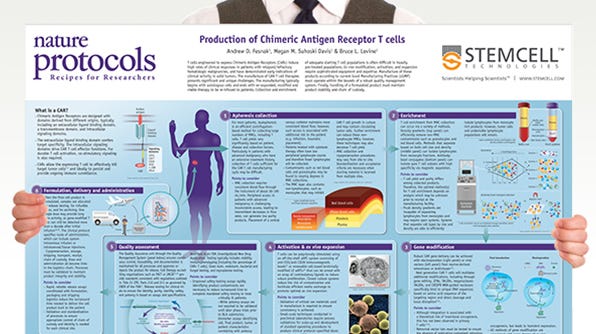
Production of Chimeric Antigen Receptor T Cells
This free Nature Protocols Wallchart summarizes the processes involved in producing CAR T cells for therapy.
Get Your Free Copy >What Is Immuno-Oncology?
Although the immune system can recognize and eliminate abnormal cells, cancer cells can develop mechanisms to escape immune surveillance and suppress anti-tumor immune responses. Tumors may alter antigen expression, upregulate immune checkpoint molecules, or create an immunosuppressive tumor microenvironment that limits the activity of T cells, natural killer (NK) cells, dendritic cells, and other immune populations. In addition, immune cells such as regulatory T cells (Tregs) and tumor-associated macrophages (TAMs) can contribute to tumor progression and metastasis.
Immuno-oncology research seeks to better understand these complex interactions between tumors and the immune system to identify new therapeutic targets and improve cancer immunotherapies. By investigating immune cell biology, the tumor microenvironment, mechanisms of immune evasion, and predictive biomarker discovery, researchers are developing more effective and personalized strategies for cancer treatment.
Cancer Immunology & Immune Modulation

Assessing Antigen-Specific T Cell Functionality with Dendritic Cell/CD8+ T Cell Co-Culture
Explore our webinar and technical bulletin to learn how to set up dendritic cell (DC) and CD8+ T cell co-culture assays and assess antigen-specific T cell activation, cytotoxic activity, cytokine production, and other functional immune responses.

Strategies to Target Macrophages in Cancer
Discover the Online Immunology Journal Club and learn about emerging immunotherapy strategies that target and reprogram tumor-associated macrophages (TAMs) to enhance anti-tumor immunity and improve cancer treatment.
Cytokines, Chemokines, and Growth Factors for Immunology and Stem Cell Research >
The Tumor Microenvironment

Isolating Mouse CD45+ Cells from Healthy Tissues and Tumors
CD45+ leukocytes, including tumor-infiltrating leukocytes (TILs), play a critical role in understanding the tumor microenvironment (TME) and anti-tumor immune responses. Explore CD45+ cell isolation strategies for healthy tissues and tumor samples to enable immune profiling and the characterization of immune cell populations within the TME.

How to Dissociate Mouse Solid Tumors into a Single-Cell Suspension
Efficient tumor dissociation is a critical first step for generating viable single-cell suspensions from mouse solid tumors. See our manual tumor dissociation protocol, optimized for breast cancer, melanoma, and colon cancer, or discover automated tumor dissociation with STEMprep™.
Isolate Tumor-Infiltrating Leukocytes (TILs) with EasySep™ >
Engineered Immune Cell Therapies

Advancing T Cell Therapies: Insights from Translational T Cell Talks
Hear from leading scientists and industry experts as they share insights into the latest developments in translational T cell research and CAR T cell innovations, including opportunities to strengthen collaboration between academia and industry.

Gene Editing Human Peripheral Blood NK Cells Using the CellPore™ Transfection System
Step-by-step protocol for gene editing of human peripheral blood natural killer (NK) cells using the CellPore™ Transfection System, enabling robust knock-out efficiency in resting NK cells while preserving cell phenotype and function.
B Cell Research & Therapeutics

Human B Cell Research Workflow
Explore tips and protocols for isolating, culturing, expanding, and analyzing human B cells, including approaches for achieving robust expansion under defined, serum-free and feeder-free culture conditions.

Mouse B Cell Research Products
Explore products for isolating, activating, expanding, and analyzing mouse B cells to support antibody discovery, B cell research, and preclinical immuno-oncology studies.
Cancer Biomarkers & Diagnostics

Circulating Tumor Cell Enrichment
Enrich rare circulating tumor cells (CTCs) from whole blood with EasySep™ and RosetteSep™ cell separation technologies. Simplify sample preparation with isolated cells ready for downstream applications.

Improve EV Biomarker Detection in Immuno-Oncology Research (On-Demand Webinar Coming Soon)
Learn how to improve the sensitivity of your EV biomarker detection by enriching extracellular vesicles of interest and reducing background noise from complex biofluids. This on-demand webinar explores practical EV isolation and depletion strategies designed to support more robust downstream biomarker research.
Human Primary Cells for Cancer Research

Human Primary Cells
Partner with a dependable human primary cells* supplier for ethically sourced, ready-to-use cells that consistently meet your requirements.

Cancer Blood Products
Choose ethically sourced cancer blood products*, including leukopaks, PBMCs, plasma, and serum from human donors with solid tumors (liver, kidney, etc.) or hematological cancers (myelofibrosis, acute myeloid leukemia, etc.).
Preclinical Cancer Models, Including New Approach Methodologies (NAMs)

Advance Immuno-Oncology Drug Development with Human-Relevant Models & NAMs
Preclinical cancer research relies on connecting in vitro data to human outcomes. Explore tools to build predictive, human-relevant models as part of new approach methodologies (NAMs) for immuno-oncology research, including tumor-immune interactions, immune modulation, target validation, and preclinical candidate evaluation.

Humanized Mouse Models & Immune Cell Isolation
Humanized mouse models enable the study of human immune responses, cancer immunotherapies, and tumor-immune interactions in vivo. Explore solutions for isolating human immune cells from mouse tissues, including the EasySep™ Mouse/Human Chimera Isolation Kit and EasySep™ Release Human CD45 Positive Selection Kit for humanized mouse samples.
Co-Culturing Colorectal Organoids and T Cells Using IntestiCult™ and ImmunoCult™ >

