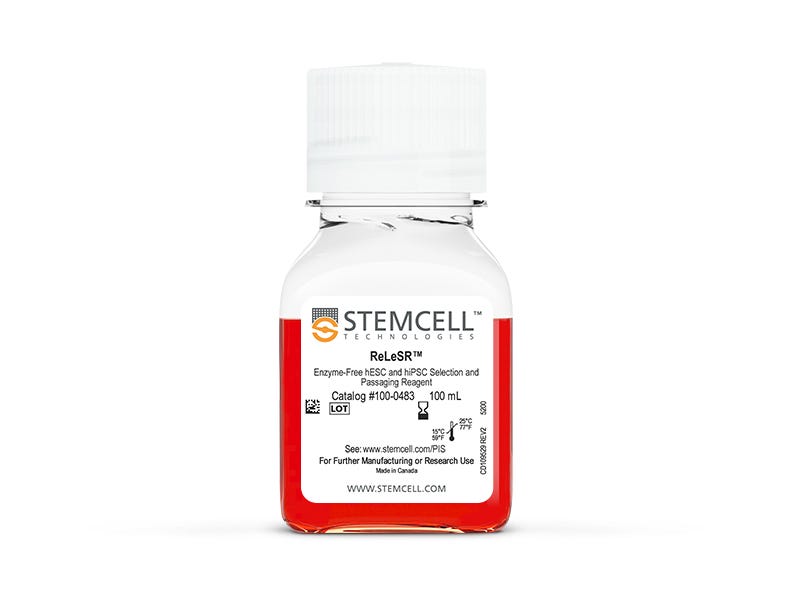
ReLeSR™

cGMP, enzyme-free human pluripotent stem cell selection and passaging reagent

ReLeSR™

cGMP, enzyme-free human pluripotent stem cell selection and passaging reagent
From: 66 USD
Catalog #
(Select a product)
cGMP, enzyme-free human pluripotent stem cell selection and passaging reagent
Add to Wish List

Product Advantages


  • Simplify cell passaging with a straightforward protocol

  • Eliminate the need for manual removal (selection) of differentiated cells

  • Generate cell aggregates without manual scraping

  • Passage cells in flasks and large culture vessels

  • Obtain quality cutures with this gentle, chemically defined, enzyme-free, GMP solution

  • Achieve high expansion of human ES/iPS cells after passaging

Overview

Efficiently dissociate and passage human embryonic stem (ES) or induced pluripotent stem (iPS) cells as aggregates without manual selection or scraping with ReLeSR™. Passaging human ES/iPS cells with ReLeSR™ easily generates optimally-sized aggregates, while eliminating the hassle and variability associated with manual manipulation. By eliminating the need for manual scraping, this enzyme-free reagent enables the use of culture flasks and other closed vessels, facilitating cell culture scale-up and automation. ReLeSR™ is manufactured following relevant cGMPs under a certified quality management system to ensure the highest quality and consistency for reproducible results.

To request a Letter of Authorization (LOA) for ReLeSR’s Drug Master File, click here.
Subtype
Non-Enzymatic
Cell Type
Pluripotent Stem Cells
Species
Human
Application
Cell Culture
Brand
ReLeSR, TeSR
Area of Interest
Stem Cell Biology

Data Figures

Passaging Protocol Comparison

Figure 1. Passaging Protocol Comparison

ReLeSR™ passaging protocol eliminates difficult and time-consuming steps, thereby enabling easy culture scale-up.
Surface area of 4 x 6 well plates (230 cm²) is comparable to that of a T225 flask (225 cm²).
TeSR™ = TeSR™ family media (mTeSR™1, TeSR™2, or TeSR™-E8™).

Selectively Detach Undifferentiated Cells

Figure 2. Selectively Detach Undifferentiated Cells

ReLeSR™ selectively detaches undifferentiated cells from pluripotent stem cell cultures without manual selection. Optimally-sized aggregates are generated following shaking/tapping of the cultureware.
(A) An hPSC culture ready for passaging. Note the presence of differentiated cells at the edge of the undifferentiated hPSC colony. (B) Following incubation with ReLeSR™, the undifferentiated hPSC colony starts to lift off of the cultureware. The differentiated cells remain attached to the cultureware. (C) Following shaking/tapping of the cultureware, the undifferentiated cells completely lift off of the cultureware. (D) The undifferentiated hPSC colony is broken up into optimally-sized aggregates for replating.

Rescue Highly Differentiated Cultures

Figure 3. Rescue Highly Differentiated Cultures

Poor quality human pluripotent stem cell cultures containing large proportions of differentiated cells can be rescued by passaging with ReLeSR™. (A) A poor quality hPSC culture containing ~50% undifferentiated cells. (B) Following passaging with ReLeSR™, the differentiated cells have largely been eliminated from the culture, with >90% undifferentiated cells present at the end of the next passage.

Select Putative iPS Cell Clones

Figure 4. Select Putative iPS Cell Clones

Easily isolate newly generated human iPS cell colonies with ReLeSR™ by selectively detaching undifferentiated cells and leaving non reprogrammed cells behind.
(A) A TeSR™-E7™ reprogramming culture which has been treated with ReLeSR™ to detach the putative iPS cell colony, leaving the non-reprogrammed and differentiated cells behind. (B) Cultures contain a high proportion of undifferentiated cells by the end of the first passage.

Protocols and Documentation

Find supporting information and directions for use in the Product Information Sheet or explore additional protocols below.

Document Type
Product Name
Catalog #
Lot #
Language
Product Name
ReLeSR™
Catalog #
100-0484, 100-0483
Lot #
Lot 1000161526 and higher For 100-0483 | Lot 1000167368 and higher For 100-0484
Language
English
Product Name
ReLeSR™
Catalog #
100-0484, 100-0483
Lot #
Lot 1000161525 and lower For 100-0483 | Lot 1000167367 and lower For 100-0484
Language
English
Document Type
Safety Data Sheet
Product Name
ReLeSR™
Catalog #
100-0484
Lot #
All
Language
English
Document Type
Safety Data Sheet
Product Name
ReLeSR™
Catalog #
100-0483
Lot #
All
Language
English

Applications

This product is designed for use in the following research area(s) as part of the highlighted workflow stage(s). Explore these workflows to learn more about the other products we offer to support each research area.

Resources and Publications

Educational Materials (18)

Publications (230)

Development and validation of a long-term co-maturation protocol for human stem cell-derived microglia and neuronal networks. A. Mordelt et al. Stem cell reports 2026 Sep

Abstract

Microglia-neuron interactions play a key role in a variety of central nervous system disorders. Technologies using human induced pluripotent stem cells (hiPSCs) have been developed to model human brain cells with the goal to understand their function. To effectively study neuro-immune crosstalk and investigate microglial contributions to neuronal network development and function, both microglia and neurons should co-mature allowing for long-term interactions throughout their differentiation. Here, we present a co-maturation protocol that robustly generates glutamatergic neuronal networks containing hiPSC-derived microglia. We validated the long-term co-cultures using single-cell transcriptomics, imaging, and neuronal activity readouts. In this protocol, astrocytes were required for long-term survival of microglia and for their integration into neuronal networks. Our co-maturation approach induced the typical ramified microglia morphology and characteristic microglia-neuron interactions. Homeostatic markers such as P2RY12 and TMEM119 and neuronal remodeling-associated genes were upregulated compared to microglia monocultures, highlighting the necessity of the environment to generate and maintain the context-dependent microglia signature in vitro. In this manuscript, we include the full optimization process of our co-maturation approach, a comprehensive description of the protocol, practical guidelines, and troubleshooting tips. Our co-maturation model provides a powerful tool to assess the role of human microglia in modulating neuronal function and development in health and disease.
ALY688 Protects Against Myocardial Ischemia-Reperfusion Injury via Direct Effects and Rab8a-Dependent Extracellular Vesicles. H. Sung et al. Journal of extracellular vesicles 2026 Sep

Abstract

Despite advances in percutaneous coronary intervention, ischemia-reperfusion (IR) injury remains a major cause of morbidity and mortality. Adiponectin confers broad cardioprotective effects, motivating the development of adiponectin receptor agonists. Here, we investigated the cardioprotective efficacy and mechanisms of ALY688, a synthetic adiponectin receptor agonist peptide, in myocardial IR injury. In a clinically translatable rat IR model, intravenous administration of ALY688 during ischemia together with subcutaneous dosing that continued for 28 days reduced troponin-I levels, cardiomyocyte death, and infarct size, while preserving cardiac function. ALY688 restored autophagic flux, mitigated reactive oxygen species accumulation, and suppressed apoptosis in both IR hearts and hypoxia-reoxygenation (HR)-treated cardiomyocytes. Proteomic profiling revealed that Rab8a, downregulated by IR, was maintained with ALY688 treatment. Notably, ALY688 increased extracellular vesicle (EV) abundance in myocardium and plasma, and EVs from treated animals displayed distinct proteomic signatures enriched in glycolytic and oxidative stress-related proteins. These EVs conferred protection against HR-induced injury in H9c2 and human iPSC-derived cardiomyocytes. CRISPR-mediated Rab8a knockout impaired ALY688-induced EV biogenesis and attenuated the cytoprotective effects of these EVs. Collectively, these findings identify ALY688 as a promising therapeutic that mitigates IR injury via both direct myocardial protection and Rab8a-dependent EV-mediated cardioprotective signalling.
Navigating Human Astrocyte Differentiation: Direct and Rapid One-Step Differentiation of Induced Pluripotent Stem Cells to Functional Astrocytes Supporting Neuronal Network Development. I. Schuurmans et al. Glia 2026 Sep

Abstract

Astrocytes play a pivotal role in neuronal network development. Despite the well-known role of astrocytes in the pathophysiology of neurologic disorders, the utilization of induced pluripotent stem cell (iPSC)-derived astrocytes in neuronal networks remains limited. Here, we present a streamlined one-step protocol for the differentiation of iPSCs directly into functional astrocytes without the need for ectopic gene expression or neural progenitor cell generation. We found that culturing iPSCs directly in commercial astrocyte medium, was sufficient to differentiate iPSCs into functional astrocytes within 5 weeks. More than 60 iPSC lines were successfully differentiated into astrocytes by independent researchers across 10 independent laboratories. Validation of the iPSC-astrocyte cultures demonstrated consistent astrocyte differentiation with minimal batch-to-batch variability. In dept. characterization of a subset of iPSC lines confirmed astrocyte identity and functionality of the iPSC-astrocyte monocultures by immunofluorescence, flow cytometry, RNA sequencing, glutamate uptake assays and calcium signaling recordings. Optimization of the protocol enabled co-culture of iPSC-astrocytes with Ngn2 iPSC-derived neurons (iNeurons), promoting neuronal differentiation and synapse formation. Lastly, we used single-cell electrophysiology and multi-electrode arrays, by four independent researchers, to confirm robust neuronal network development in 5-week-old iPSC-astrocyte and iNeuron co-cultures. This protocol offers a rapid and efficient method to establish all-human astrocyte-neuron co-cultures, facilitating the investigation of cell-type-specific contributions to disease pathogenesis. Its validation across numerous iPSC lines in 10 independent laboratories highlights the reproducibility of the protocol and positions it as a platform for advancing disease modeling in human neural networks.